
Access, assistance and community
Pawsitive Action Leeds CIC is a disabled-led Community Interest Company based in Leeds.
We work to make assistance dogs and assistance-dog support more accessible, ethical and inclusive.
That means more than providing dog-training sessions. We support people to understand their options, build an individual pathway, find appropriate professionals, access assessments and challenge the wider barriers assistance-dog handlers face.
We also work with businesses, transport providers, public services and decision-makers to create lasting improvements in awareness, policy and accessibility.
Our mission is simple: to make assistance dogs accessible to all.
Why PAL CIC Exists
PAL CIC grew from lived experience.
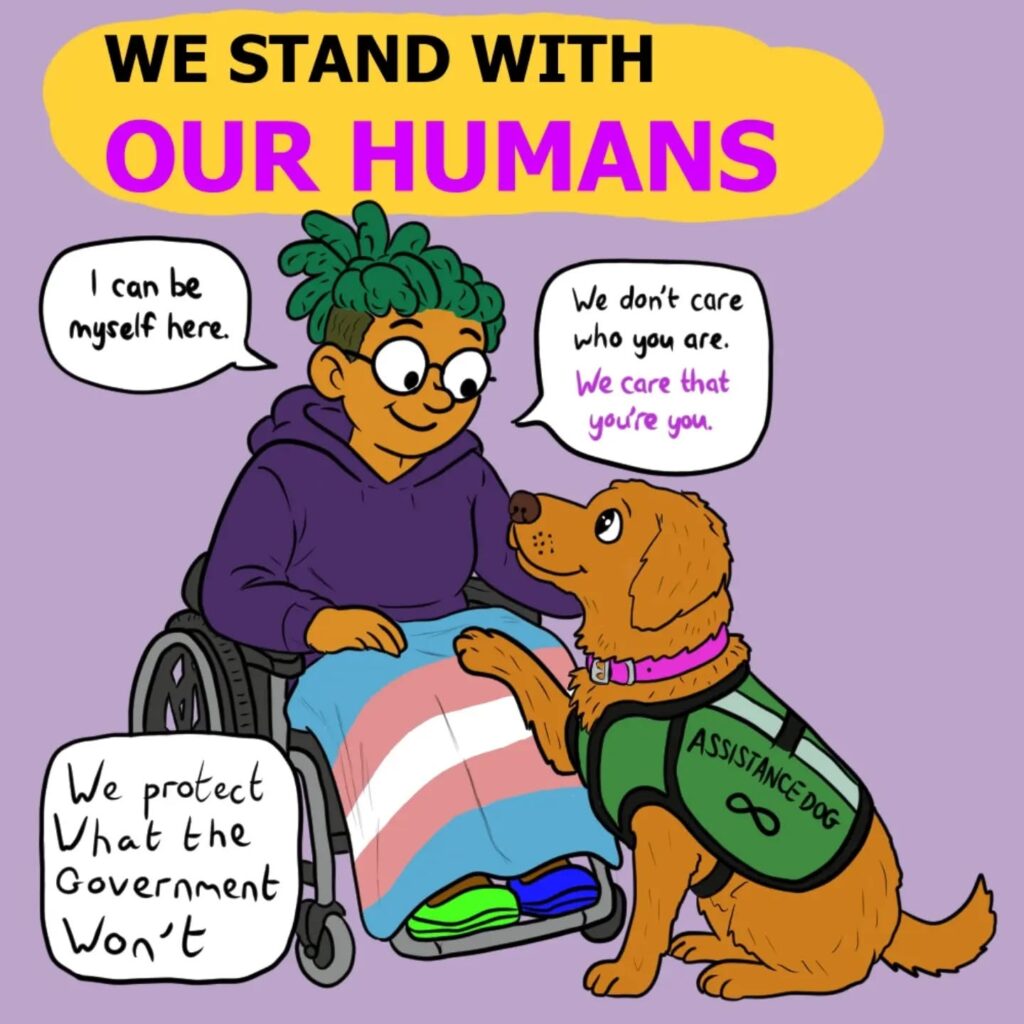
Our founder, Paws, is a disabled, neurodivergent, and trans assistance dog handler. Their own journey with their assistance dog, Enola, showed both how life-changing an assistance dog can be and how difficult the journey can become.
Enola is the reason PAL CIC exists.
Finding clear information, appropriate training and inclusive support should not be another exhausting system for disabled people to navigate.
Yet many people face:
- Long waiting lists
- Restrictive eligibility criteria
- High private-training costs
- Inconsistent or misleading information
- Difficulty finding ethical trainers
- Inaccessible training environments
- A lack of support for owner-trained teams
- Discrimination from businesses and transport providers
- Pressure to repeatedly prove or explain their disability
- Services that do not understand neurodivergence, trauma or fluctuating health
- Systems that consider the person and the dog separately
PAL CIC was created to do things differently.
We believe the wellbeing of the disabled person and the welfare of the dog are inseparable.
What Does “Accessible to All” Mean?
Making assistance dogs accessible does not mean promising that every person will receive a dog or that every dog will be suitable for assistance work.
It means working to remove unnecessary financial, physical, geographical, social and institutional barriers.
For PAL CIC, accessibility means:
- Providing honest and understandable information
- Supporting owner-trained as well as organisation-trained teams
- Recognising visible and non-visible disabilities
- Making reasonable adjustments
- Respecting different communication and learning needs
- Helping people find suitable local or remote support
- Keeping costs as accessible as our resources allow
- Offering funded or subsidised opportunities where possible
- Supporting informed choice
- Challenging inaccurate information and discriminatory policies
- Prioritising the welfare of every dog
- Being honest when an assistance dog may not be the right option
Accessibility is not about lowering welfare or public-safety standards. It is about giving people a fair opportunity to understand and meet them.
More Than Dog Training
PAL CIC began with a strong focus on accessible training for dogs and assistance dogs. As our work developed, it became increasingly clear that training the dog was only one part of the problem.
A beautifully trained assistance dog cannot remove a business’s inaccessible policy.
It cannot make a taxi driver accept a journey.
It cannot correct misinformation about owner-trained teams.
It cannot make an employer, college or public service understand reasonable adjustments.
That is why PAL CIC’s work has grown.
Today, our activities include:
- The PAL Assistance Dog Pathway
- Guidance for prospective and existing assistance-dog handlers
- Support for owner-trained teams
- Temperament and suitability assessments
- Training-progress reviews
- Public Access Tests
- Limited specialist assistance-dog training
- Referrals to appropriate independent dog trainers
- Advocacy following access barriers
- Assistance-dog awareness training
- Organisational policy support
- Community education and outreach
- Engagement with councillors, MPs and public bodies
- Work to improve transport and public access
- Community connection and peer support
Our goal is not to build the largest client list.
Our goal is to create better access.
The PAL Assistance Dog Pathway
There is no single route that works for every assistance-dog partnership.
Through the PAL Assistance Dog Pathway, we help people identify the combination of support that may be right for them.
This could include:
- Initial guidance
- Help considering whether an assistance dog is appropriate
- Prospect-dog or temperament support
- An individual Assistance Dog Support Plan
- Limited training from PAL CIC
- Support from an independent trainer
- Progress and welfare reviews
- Public-access preparation
- A Public Access Test
- Advocacy and continuing support
PAL CIC does not need to deliver every training session to remain part of the person’s journey.
By working with ethical independent professionals, we can help more people access relevant support closer to where they live while keeping specialist pathway guidance, assessment and advocacy connected.
Our Values
Disabled-Led
PAL CIC is shaped by disabled people and lived experience.
We understand that accessibility can involve much more than physical access. It may also involve fatigue, pain, sensory needs, communication, processing time, executive functioning, anxiety, trauma, finances and unpredictable health.
Disabled people are not an afterthought within our services.
Welfare-Centred
The handler’s needs matter, but the dog’s wellbeing is never secondary.
We use and promote ethical, reward-based training. We will not recommend that a dog continue assistance work where doing so would be unsafe, unrealistic or harmful.
Sometimes, slowing down, changing the plan or withdrawing a dog from assistance work is the kindest and most responsible outcome.
Individual
Every person, dog and partnership is different.
We do not believe in forcing everyone through an identical programme. Support should reflect the person’s goals, the dog’s temperament and abilities, the required tasks, accessibility needs and the partnership’s changing circumstances.
Inclusive
PAL CIC welcomes people from all backgrounds and is explicitly LGBTQ+ inclusive.
We recognise that disabled, neurodivergent and LGBTQ+ people can face overlapping barriers when seeking support.
People should not have to hide part of themselves to be treated with dignity.
Honest
Assistance dogs can be life-changing, but they are not the right option for everyone.
We will be honest about:
- The commitment involved
- Likely costs and timescales
- Training and welfare concerns
- The possibility that a dog may not be suitable
- What PAL CIC can and cannot provide
- The limits of assessments and certificates
- When another professional or service may be more appropriate
Honesty protects both the person and the dog.
Collaborative
No single trainer or organisation can provide every form of support in every location.
We believe in working with people who share our values while keeping professional roles and responsibilities clear.
Collaboration helps us connect people with the right expertise without expecting one professional to claim knowledge they do not have.
Transparent
We aim to be open about:
- Our services and limitations
- Prices and payment arrangements
- How referrals work
- Independent trainer relationships
- Our 5% referral fee
- Assessment standards
- Conflicts of interest
- How PAL CIC’s income is used
Trust requires more than good intentions. It requires clear information and accountability.
Owner-Trained Assistance Dogs
PAL CIC supports the right of disabled people to explore owner-training with appropriate information, guidance and welfare safeguards.
We do not believe an assistance-dog partnership should be dismissed simply because the dog was not supplied by a large organisation.
At the same time, owner-training should not mean being expected to manage every part of the journey alone.
People deserve access to:
- Honest guidance
- Ethical training
- Suitable assessments
- Welfare support
- Accessible information
- Professional referrals
- Public-access preparation
- Advocacy when barriers arise
Supporting owner-trained teams does not mean automatically approving every dog. Our decisions remain grounded in individual suitability, welfare and safety.
Creating Wider Change
Many of the barriers faced by assistance-dog handlers cannot be solved through individual training.
PAL CIC also works to create change by:
- Delivering assistance-dog awareness sessions
- Helping organisations improve policies and procedures
- Supporting handlers through access complaints
- Working with transport and taxi providers
- Raising recurring concerns with public bodies
- Engaging with councillors and MPs
- Contributing lived-experience insight
- Challenging myths and misinformation
- Encouraging accessible complaint systems
- Collecting anonymised evidence of recurring barriers
Our organisational work is politically impartial. That does not prevent us from challenging discrimination or asking decision-makers to improve disabled people’s access.
Community and Connection
Assistance-dog journeys can be isolating.
PAL CIC aims to create opportunities for people to:
- Meet others with similar experiences
- Learn without judgement
- Ask questions
- Build confidence
- Share practical knowledge
- Feel part of a supportive community
Our community activities may include social events, workshops, accessible resources and peer connection.
We believe people need more than a training plan. They need to feel understood, respected and less alone.
Our Community Interest
PAL CIC is a Community Interest Company.
We are not here to generate private profit or build the biggest possible client list.
Income from services, commissioned training, referral fees, fundraising and grants supports our community purpose, including:
- Accessible assistance-dog guidance
- Reasonable adjustments
- Referral and pathway coordination
- Advocacy
- Community education
- Organisational training
- Resources and systems
- Subsidised support where funding allows
- The PAL CIC Solidarity Fund
Any surplus is reinvested into PAL CIC and its community purpose rather than distributed as private profit.
Further information is available through our Financial Transparency information.
Based in Leeds, Working for Wider Change
PAL CIC is based in Leeds and has strong roots within our local disabled and assistance-dog communities.
Our work has included:
- Supporting assistance-dog handlers and owner-trainers
- Providing assessments and training
- Delivering community workshops
- Creating accessible guidance and resources
- Supporting access complaints
- Raising concerns about taxi refusals
- Engaging with Leeds services and decision-makers
- Providing assistance-dog awareness training
- Being listed on the Leeds Local Offer
Our direct, in-person capacity may depend on location and available resources. However, partnerships, remote support, advocacy and organisational work can help our impact reach beyond one trainer or one postcode.
Meet the People Behind PAL CIC
PAL CIC is led by people who believe that lived experience, professional responsibility and community accountability should work together.
Our directors bring different experiences and perspectives while sharing responsibility for PAL CIC’s community purpose.
Work With Us
There are several ways to become part of PAL CIC’s work.
You can:
- Contact us about assistance-dog support
- Ask about an assessment
- Request advocacy
- Arrange training for your organisation
- Join our independent trainer network
- Attend a community event
- Support the PAL CIC Solidarity Fund
- Donate or fundraise
- Partner with us on a project
- Share our accessible resources
Contact PAL CIC
If you are unsure where to begin, you do not need to choose the correct service before contacting us.
Email contact@palcic.org with a brief explanation of what you need, and we will help you identify the most appropriate next step.
Disabled-led. Welfare-centred. Assistance dogs accessible to all.
What are people saying?
Can’t recommend this company enough!!! Paws has been training me and Bonnie and from the moment we met them they were so friendly and easy to talk to.
The training is going so well so far and the future just sounds amazing for me and Bonnie. So glad we found and joined pawsitive!! Thank you for everything you are doing for us
Training my Assistance dog – I have had two training sessions with Paws. The first one was at my house so Paws could see how my dog was behaving, what was good, not so good and needed work on. I took the advice and started to use it in my training sessions with my dog. A few weeks later we had a Zoom call to discuss how things had been going and what we should work on next. The session was excellent and very professional. I think it was better in some ways because my dog was not distracted by picking up the smell of Paws’ dog on their clothes. As Paws was explaining the next steps I learnt how to “charge the clicker” which happened very quickly, this is particularly important for me as I have a medical disorder that affects my voice making me almost inaudible. I am confident that with Paws’ assistance I will be able to train me and my dog to allow her to become a good, happy and essential part of my life
I had been having a wonderful experience with Pawsitive Action. They were incredibly informative, approachable, and genuinely supportive from the first conversation. Their guidance has given me real hope and confidence in training my dog to become an assistance dog for my condition. They provided clear, appropriate information and made the whole process feel far less overwhelming. I truly appreciate their professionalism and kindness, and I highly recommend their services.